
Waste Reduction – Landfill and Recycling
Far reaching changes are coming to all aspects of the waste stream. By 2030, Commonwealth and State legislation will require a reduction in total waste generated in Australia of 10% per person and a resource recovery rate of 80%.
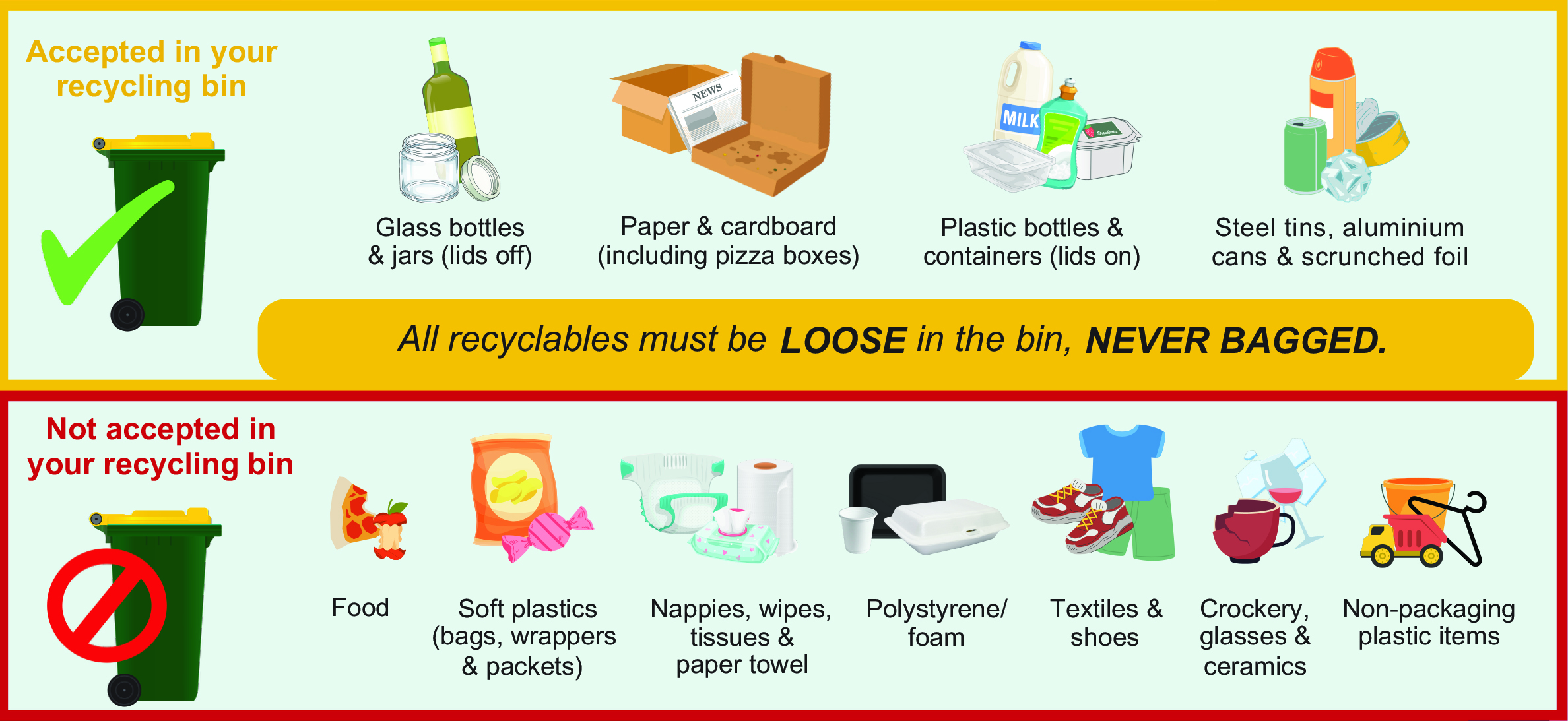
In order to address these issues, Dungog Shire developed the Waste Management Strategy and Action Plan 2023-2043 that is available on Council’s website, which also details what can be placed in the recycling bins and the services are available at the landfill.
The strategy considers options for extending the expected life of the Dungog landfill, which is a major issue because remediating the site will be expensive as will options for replacing it in a drinking water catchment.
The introduction of a third kerbside bin for food and garden waste (FOGO) would significantly reduce waste to landfill and the material would be converted to compost. FOGO could extend our landfill by up to 8 years, and it will become mandatory for all Councils anyway. So Council is investigating options to introduce it when the current kerbside waste collection contract expires in October 2027. Our team will be assessing what has worked and not worked in other Councils
Last year, the total waste delivered to our landfill was 9,600 tonnes, of which kerbside & municipal waste totaled 3,080 tonnes. General mixed, construction & demolition materials and flood waste added 2,840 tonnes. About 3,6oo tonnes of soils were used to cover the putrescible domestic waste.
We diverted 820 tonnes of waste from the landfill including 560 tonnes of scrap metal, 85 tonnes of various materials like batteries, oil, e waste, paper and soft plastics etc that were collected at the landfill. There was about 170 tonnes of green waste. The 4,258 yellow lid bins of the recycling service diverted 622 tonnes from our landfill.
The NSW Government’s Waste Levy requires Council to account for waste added to the landfill. This levy was introduced to encourage waste reduction, and charges are expected to increase markedly by 2030. Last year, we paid the NSW Government a staggering $504,694 under the waste levy.
Ratepayers share the cost of managing our waste operations and charges are essentially cost neutral as Council does not profit from them. We need increased efforts to reduce, reuse and recycle if we are to meet government targets and contain the cost of operating waste services.
At the present time local communities have to deal with packaging at the wrong end of the waste stream and far too much goes into landfill at our expense. Strong government action is required in that regard.
Problematic and unnecessary plastics were to be phased out by 2025 but this did not happen. We are told that “new legislation will require packaging to be reusable, readily recycled or compostable, and require a 50% content of recycled material in plastic packaging. Problematic and unnecessary plastics will be phased out. New laws will require packaging to be reusable, readily recycled or compostable, and require a 50% content of recycled material in plastic packaging”. We hope so.
Plastic Bottle Tops
The lids can now be left on plastic bottles when placed in the yellow recycling bins. The JR Richards Waste Recycling Facility at Tuncurry now crushes and bales them with the lids attached. They are sent to partner organizations where they are reduced to plastic flakes and separated in water tanks where lid-related flakes float and the bottle flakes sink.
Your local B Ward Councillors:
James Campbell 0484 599 709
james.campbell@dungog.nsw.gov.au
Steve low 4996 4022 steve.low49@gmail.com